Brain Folds: Evolution, Species Differences, and Cognitive Power
Imagine crumpling a sheet of paper into a tight ball. You’ve just intuitively demonstrated one of the most profound mysteries of brain development: how our brains acquire their characteristic folds. On the surface, a brain and a piece of paper may seem to have little in common, yet the act of folding is central to understanding the incredible processing power packed within our skulls. This intricate "origami" of the brain is not merely aesthetic; it's a testament to millions of years of evolution, a key determinant of cognitive ability, and a fascinating puzzle for neuroscientists worldwide.
The highly convoluted surface of the human brain, with its peaks (gyri) and valleys (sulci), stands in stark contrast to the smoother brains of many smaller creatures. These intricate patterns are not random; they are the result of a complex developmental process known as girification. Understanding why some species possess elaborately folded cortices while others maintain a relatively Cerebro Liso (smooth brain) offers deep insights into the evolution of intelligence and the critical architecture underpinning our highest cognitive functions.
The Evolutionary Imperative of Brain Folds
Many scientists concur that the primary evolutionary driver behind brain folding is surprisingly practical: real estate. As species evolved and their cognitive demands grew, so did the size of the cerebral cortex – the brain's outer layer responsible for perception, memory, language, and complex thought. However, there's a limit to how large a skull can grow, especially for species that need to pass through a birth canal or maintain an agile head. Folding allows a much larger cortical surface area to be packed into a comparatively smaller cranial cavity.
Think of it as expanding your brain's processing capacity without needing a disproportionately giant head. A greater surface area means more neurons, more synaptic connections, and ultimately, more power to receive, process, and integrate information. This exponential increase in computational real estate is directly linked to enhanced cognitive abilities, enabling complex problem-solving, abstract thought, and sophisticated social interactions.
This evolutionary advantage, however, isn't exclusive to humans. Many other highly intelligent mammals exhibit similarly elaborate brain folds. Dolphins, with their renowned communication skills, and elephants, known for their complex social structures and memory, are prime examples. Primates, like monkeys, also display intricate cortical patterns, underscoring the widespread evolutionary benefit of girification.
A World of Wrinkles: Species Differences and Puzzling Patterns
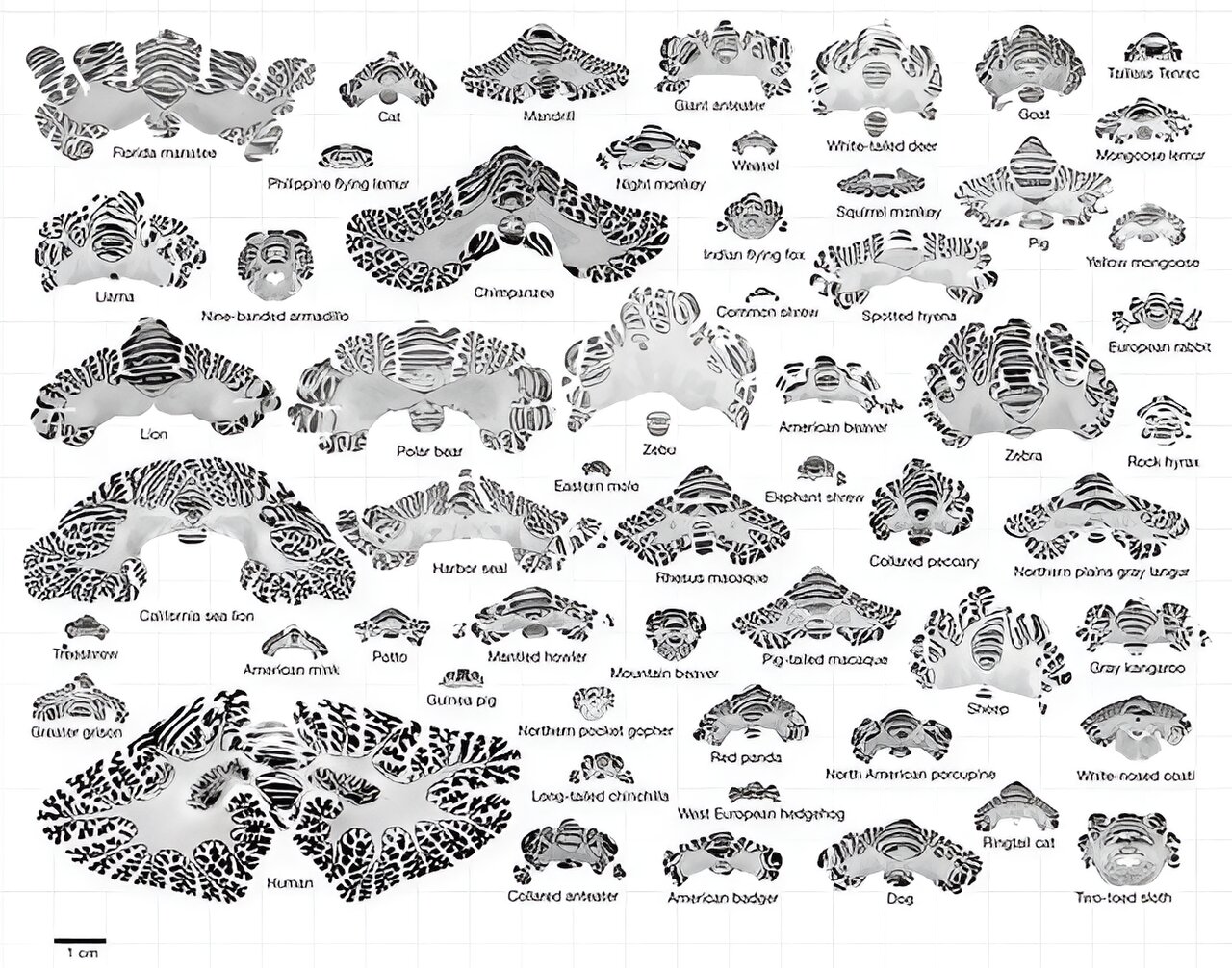
While the general rule of thumb suggests that larger species tend to have more folded brains, and smaller species often possess a more Cerebro Liso (smooth brain), the reality is far more nuanced. For instance, tiny mammals like mice and rats typically have very few cortical folds, if any, maintaining a largely smooth brain surface. This led to an initial hypothesis: the larger the brain, the more folds it would have.
However, this simple correlation quickly broke down under closer scientific scrutiny. Consider the dolphin: these marine mammals have brains comparable in size to humans, yet astonishingly, they exhibit twice the number of folds! This observation challenged the size-equals-folds theory. Another paradox arises when comparing humans and elephants. Human cortices possess three times more neurons than elephants, yet elephants have considerably more folds than we do. This further complicates the picture, revealing that neither brain size nor neuron count alone fully explains the extent of cortical folding.
So, what *are* the mechanisms behind these dramatic interspecies differences? Scientists are still actively exploring this question. Factors beyond sheer size or neuron numbers likely play a role, including cortical thickness, the tension exerted by underlying white matter fibers, and specific genetic programming that dictates cellular proliferation and migration during development. The intricate interplay of these biomechanical and genetic forces shapes the unique folding patterns observed across the animal kingdom, highlighting the profound complexity of brain development. For some species, a Cerebro Liso is perfectly normal and healthy, reflecting their evolutionary trajectory and cognitive demands.
The Miraculous Process of Girification: How Folds Form
The formation of these intricate folds, known as girification, is a marvel of developmental biology. In humans, the journey begins remarkably smoothly. For the first approximately 20 weeks of fetal development, the human brain is largely a Cerebro Liso – a smooth, unwrinkled sphere. It is only after this period that the cortex undergoes a dramatic transformation.
The turning point arrives with an immense increase in the number of brain cells, particularly in the outer layers of the cortex. This rapid proliferation and expansion of cells lead to a significant increase in cortical surface area. Because the skull volume remains relatively constrained, the expanding cortex begins to buckle and fold inward upon itself, forming the characteristic gyri (ridges) and sulci (grooves).
These initial folds then elongate and branch, gradually developing into the complex topographical map seen at birth. While some minor folding can continue after birth, the majority of the intricate patterns are established during the second half of gestation. Researchers are intensely investigating the molecular triggers for this process, with a molecule called Trnp1 being identified as a potential key player in promoting the cortical expansion and subsequent folding. To delve deeper into the fascinating mechanics of this developmental phenomenon, you can explore Unraveling Brain Folds: The Mystery of Girification Explained.
When a Cerebro Liso Is Not Normal: The Human Experience
While a relatively Cerebro Liso is the norm for smaller mammals like rats and cats, for humans, a smooth brain is a sign of a severe neurological disorder known as lissencephaly. This condition, where the brain fails to develop its characteristic folds, has devastating consequences for human function.
Consider the poignant case examined by Jean Marc Pinard in 1989. An eight-year-old child with a completely smooth cerebral surface, as revealed by an MRI scan, exhibited profound impairments. The child was unable to even sit up, their eyes oscillated rapidly and without contact with the external world, and their body was frequently wracked by seizures. This unfortunate individual's inability to function highlighted the indispensable role of cortical folds in human cognition and motor control.
For humans, a lack of gyri and sulci means a drastically reduced cortical surface area, which translates to a severe deficiency in the number of neurons and synaptic connections necessary for complex thought, movement, and sensory processing. The intricate folds are crucial not just for increasing surface area, but also for organizing brain regions, facilitating efficient communication between different areas, and forming the specialized "maps" essential for our unique capabilities. Without these folds, the brain cannot process information effectively, leading to profound developmental delays, intellectual disabilities, and severe physical impairments. To understand more about the critical importance of these folds for human health, refer to Why a Smooth Brain Isn't Healthy: Essential Folds for Human Function.
Conclusion
The journey from a flat sheet of neural tissue to the intricately folded human brain is a testament to evolutionary efficiency and developmental precision. Brain folds are not mere aesthetic features; they are crucial architects of cognitive power, enabling the complex processing capabilities that define our species and many other highly intelligent mammals. While the precise mechanisms governing the extent and pattern of girification across species remain an active area of research, the overarching principle is clear: more surface area generally equates to greater potential for sophisticated brain function.
From the gracefully folded cortices of dolphins to the relatively Cerebro Liso of a mouse, the diversity of brain topography reflects a vast spectrum of evolutionary adaptations. However, for humans, those countless ridges and valleys are not just an evolutionary advantage; they are an absolute necessity. They are the physical manifestation of our capacity for thought, emotion, and interaction with the world, making the understanding of brain folds a cornerstone of modern neuroscience.